Stopped along beautiful Loch Locky for a picnic Rita laid out on the car hood
View of Loch Garry on the way to the Glenelg Ferry
Spectacular reflections of the hills and sky in Lock Loyne along the one track road to Glenelg
In the Glen Shiel (valley) with the impressive Gran Bretana in the background
View from the 1,100 ft (370m) summit of Morn Ratagan Pass
The manually turned "turntable" ferry that takes you from Glenelg to the Isle of Skye
We are heading to the Isle of Skye today and there are three ways to get there by car and we have chosen the least used way to get there thanks to Fiona Frost. Before leaving Vancouver, Fiona told us about this unique ferry trip from the mainland to the Island and so when the time came we programmed our Tom Tom and away we went. Thank you Fiona as this was the most exhilarating experience I have had since coming to the UK. The one track road was very intense as it took us over some gripping terrain, spectacular scenery and a very quaint ferry crossing. By the time we hit the main road on the Isle of Skye we could not stop talking about the wonderful four hours we had spent getting here. We found our B&B without any problems unfortunately it was the first time we have been disappointed with our choice of accommodation. The place was showing its age and it seemed the owners did not really care about their guests experience, just their money. Thank goodness we had a nice bed so we could get a good nights sleep as we were going to have a full day tomorrow exploring the Isle of Skye.
Wednesday, June 22, 2011
Tuesday, June 21, 2011
Island Hopping - Iona
Iona medieval Nunnery ruins
13th Century Iona Abbey has been rebuilt many times as the Island was ofter attacked by Vikings
On one of Iona's spectacular white sand beaches
Rita getting up close and personal with some of Iona's locals
Iona is a very small Island but is famous as the birthplace of Christianity in Scotland. St. Columba, an Irish priest left Ireland and landed on Iona in 563 and established an Abbey. His monastic community flourished and Iona became the centre for Celtic Christianity. In fact, several ancient Scottish and Scandinavian Kings were buried on Iona, including Shakespears Macbeth. Today, Iona is a very pretty and tranquil place that makes its living from tourism, sheep farming and fishing. We had a wonderful 2 hours strolling around the island before heading back to catch the ferry for the short ride back to the Isle of Mull.
13th Century Iona Abbey has been rebuilt many times as the Island was ofter attacked by Vikings
On one of Iona's spectacular white sand beaches
Rita getting up close and personal with some of Iona's locals
Iona is a very small Island but is famous as the birthplace of Christianity in Scotland. St. Columba, an Irish priest left Ireland and landed on Iona in 563 and established an Abbey. His monastic community flourished and Iona became the centre for Celtic Christianity. In fact, several ancient Scottish and Scandinavian Kings were buried on Iona, including Shakespears Macbeth. Today, Iona is a very pretty and tranquil place that makes its living from tourism, sheep farming and fishing. We had a wonderful 2 hours strolling around the island before heading back to catch the ferry for the short ride back to the Isle of Mull.
Monday, June 20, 2011
Island Hopping - Staffa
Staffa Island is an old Norse name meaning pillar island due to its basalt columns
Climbing away from the boat and dock on Staffa Island
Fingals Cave was created by sea erosion and is currently 60 ft high (20m) and 225 ft long (75m)
Looking back from the other end of Staffa Island where Puffins nest on the cliffs
Staffa is a tiny uninhabited island 6 miles off shore from the Isle of Mull. It was privately owned until the last owner (an American) donated it to the Scottish National Trust. Tourists can come by authorized boats to spend an hour exploring the island. Walkways take you to the entrance of the cave and it's quite amazing to see how the power of the waves has created this massive cave. The rest of the island is quite rugged with several trails leading to the steep cliff edges that are home to a number of seabirds including the puffin. Unfortunately, we did not see any while on the island but saw several flying around when we were in the boat.
Climbing away from the boat and dock on Staffa Island
Fingals Cave was created by sea erosion and is currently 60 ft high (20m) and 225 ft long (75m)
Looking back from the other end of Staffa Island where Puffins nest on the cliffs
Staffa is a tiny uninhabited island 6 miles off shore from the Isle of Mull. It was privately owned until the last owner (an American) donated it to the Scottish National Trust. Tourists can come by authorized boats to spend an hour exploring the island. Walkways take you to the entrance of the cave and it's quite amazing to see how the power of the waves has created this massive cave. The rest of the island is quite rugged with several trails leading to the steep cliff edges that are home to a number of seabirds including the puffin. Unfortunately, we did not see any while on the island but saw several flying around when we were in the boat.
Island Hopping -Isle of Mull
On the bus looking at one of the Isle of Mull's many steep, fog covered hillsides
Fishing boats in Port Fionnphort harbour on the Isle of Mull
One of the many Isle of Mull red deer stag's
A beautiful valley with 3 small lakes on the Isle of Mull
Isle of Mull is the third largest in Scotland with 300 miles (500km) of coastline and one of the largest mountains in Britain called Ben More (Big Mountain). We were not stopping to see any of the sights as we got off the ferry and onto a bus that took us to a boat located at the other end of the island. It was a beautiful drive in both directions as we travelled through many valleys, inlets and hills. All of it on a one track road, which was quite impressive considering we were in a 56 passenger bus.
Fishing boats in Port Fionnphort harbour on the Isle of Mull
One of the many Isle of Mull red deer stag's
A beautiful valley with 3 small lakes on the Isle of Mull
Isle of Mull is the third largest in Scotland with 300 miles (500km) of coastline and one of the largest mountains in Britain called Ben More (Big Mountain). We were not stopping to see any of the sights as we got off the ferry and onto a bus that took us to a boat located at the other end of the island. It was a beautiful drive in both directions as we travelled through many valleys, inlets and hills. All of it on a one track road, which was quite impressive considering we were in a 56 passenger bus.
Island Hopping - Ferry from Oban to Isle of Mull
Lismore Lighthouse from the Ferry on the way from Oban to Isle of Mull
Duart Castle on the Isle of Mull from the Ferry
On board the Caledonian Ferry heading towards the Isle of Mull
We had an amazing tour today exploring three islands (Mull, Staffa and Iona) that included taking a ferry, bus, boat, bus and ferry. The day started overcast but ended up sunny and warm, just the way Rita likes it. We boarded the ferry from Oban Harbour at 09:50 and arrived back at 19:45. It was a full but wonderful day of exploring. The journey included a 45 minute ferry ride from Oban to the Isle of Mull, a 1.5 hour bus ride that took us on a wondrous scenic journey to the other end of the Island (about 30 miles (50km)), a 35 minute ride on a 50 passenger boat to the Island of Staffa with an hour to explore the Island, back on the boat for another 35 minute ride to the Island of Iona with two hours to explore the Islands nunnery ruins, Abbey and white sands beaches, a 10 minute ferry ride back to the Isle of Mull to pick up the bus for the 90 minute ride back to the ferry that would take us into Oban Harbour. Whew!!!! It was a very full day but we thoroughly enjoyed the time we spent exploring the Islands of Staffa and Iona. Dead tired by the time we got back so we headed to a recommended restaurant for a very good pizza and beer.
Duart Castle on the Isle of Mull from the Ferry
On board the Caledonian Ferry heading towards the Isle of Mull
We had an amazing tour today exploring three islands (Mull, Staffa and Iona) that included taking a ferry, bus, boat, bus and ferry. The day started overcast but ended up sunny and warm, just the way Rita likes it. We boarded the ferry from Oban Harbour at 09:50 and arrived back at 19:45. It was a full but wonderful day of exploring. The journey included a 45 minute ferry ride from Oban to the Isle of Mull, a 1.5 hour bus ride that took us on a wondrous scenic journey to the other end of the Island (about 30 miles (50km)), a 35 minute ride on a 50 passenger boat to the Island of Staffa with an hour to explore the Island, back on the boat for another 35 minute ride to the Island of Iona with two hours to explore the Islands nunnery ruins, Abbey and white sands beaches, a 10 minute ferry ride back to the Isle of Mull to pick up the bus for the 90 minute ride back to the ferry that would take us into Oban Harbour. Whew!!!! It was a very full day but we thoroughly enjoyed the time we spent exploring the Islands of Staffa and Iona. Dead tired by the time we got back so we headed to a recommended restaurant for a very good pizza and beer.
Oban
Kilchrenan House, our B&B lodging that faces the ocean. We were staying in the top right dormer
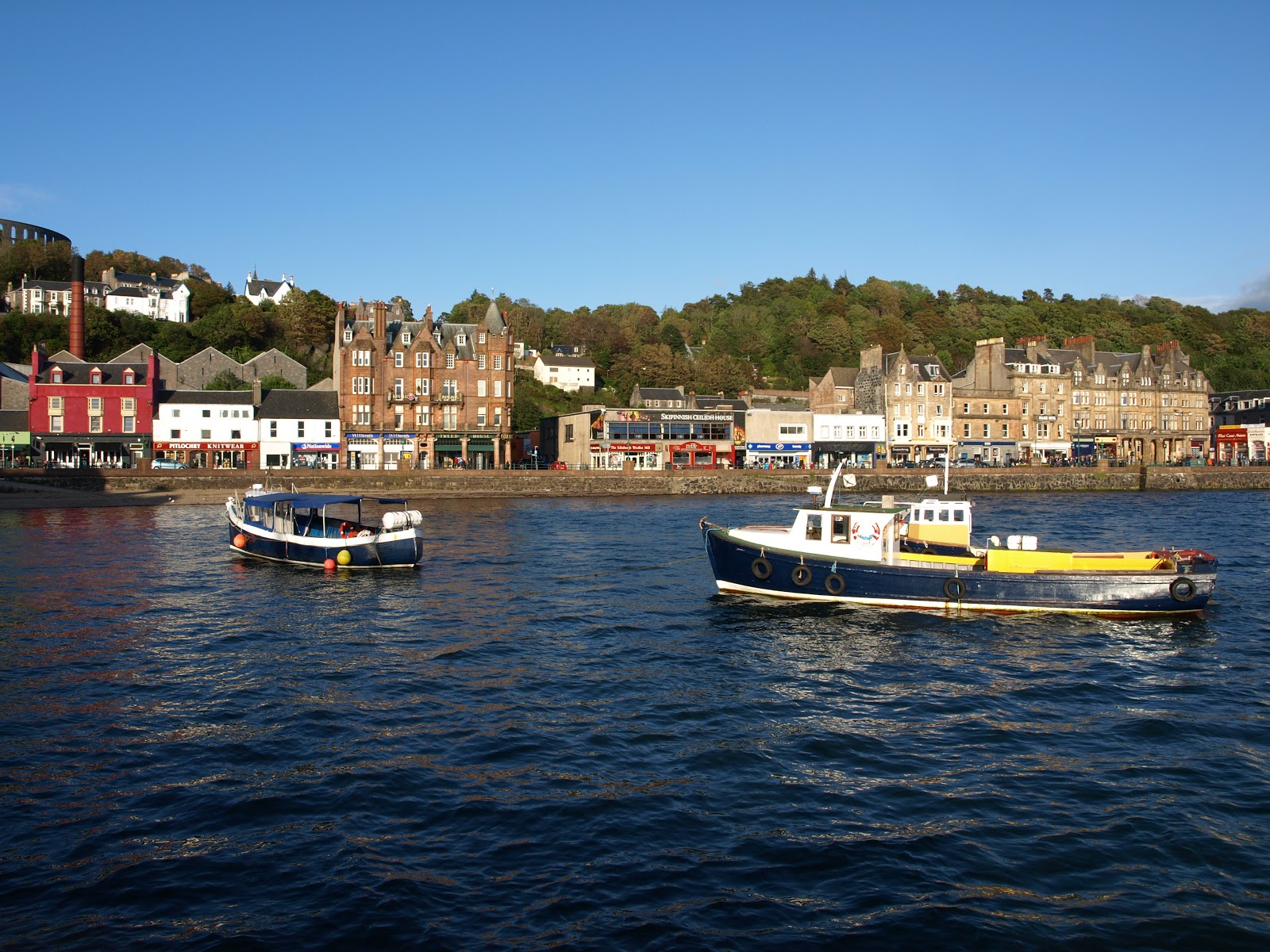
Looking at Oban Village and Inner Harbour with small fishing boats
Fishing boat dock located at South Pier in Oban Bay
Looking out from Oban Bay to Kerrera Island that protects Oban from North Atlantic storms
15th century Dunollie Castle ruins on the outside edge of Oban Bay
Woke up to sunshine and quickly went out to take pictures of Oban in case the weather changes. Oban (pronounced OH-bin) is called the "gateway to the Isles" as it has busy ferry and train terminals. Oban means "the little bay" in Scottish Gaelic and is located in a near perfect horseshoe bay. Small fishing boats still ply the waters and there are several mussel and salmon farms in the area. However, the big attraction for me is the Oban Distillery, makers of very fine 14 year old scotch whisky. They say that the distillary, founded in 1794, was responsible for the creation of the modern town we see today. And who said scotch was bad for you? We did the distillery tour and it was informative and very, very tasty.
Looking at Oban Village and Inner Harbour with small fishing boats
Fishing boat dock located at South Pier in Oban Bay
Looking out from Oban Bay to Kerrera Island that protects Oban from North Atlantic storms
15th century Dunollie Castle ruins on the outside edge of Oban Bay
Woke up to sunshine and quickly went out to take pictures of Oban in case the weather changes. Oban (pronounced OH-bin) is called the "gateway to the Isles" as it has busy ferry and train terminals. Oban means "the little bay" in Scottish Gaelic and is located in a near perfect horseshoe bay. Small fishing boats still ply the waters and there are several mussel and salmon farms in the area. However, the big attraction for me is the Oban Distillery, makers of very fine 14 year old scotch whisky. They say that the distillary, founded in 1794, was responsible for the creation of the modern town we see today. And who said scotch was bad for you? We did the distillery tour and it was informative and very, very tasty.
Subscribe to:
Posts (Atom)